The Secret Skill for Talking to AI: What is Prompting?
Have you ever asked an AI a question and gotten a boring, generic, or totally unhelpful answer? It can be frustrating. You know the AI is powerful, but it's not giving you what you want. The problem might not be the AI—it might be how you're asking.
Learning to talk to an AI is a new skill, and the instruction you give it is called a Prompt.
Think of the AI as a very powerful but very literal genie in a lamp. If you vaguely wish for "food," you might get a pile of dry crackers. But if you wish for "a hot, delicious pepperoni pizza with extra cheese," you'll get exactly what you wanted. Prompting is how you make a specific wish.
What is a Prompt?
A prompt is simply the question or command you type into an AI like ChatGPT. It's the starting point for everything the AI does.
- A bad prompt is vague and gives the AI too much room to guess.
- A good prompt is clear, specific, and gives the AI all the clues it needs to be successful.
The quality of the AI's answer almost always depends on the quality of your prompt.
The Difference a Good Prompt Makes
Let's look at a simple example. Imagine you want the AI to write something about dogs.
A Bad Prompt:
"Tell me about dogs."
The AI has no idea what you really want. A scientific report? A poem? A story? It will probably give you a generic, boring encyclopedia article about the history of dogs.
A Good Prompt:
"Write a short, funny poem for a 5-year-old about a clumsy golden retriever puppy who loves to play in the mud."
See the difference? Now the AI knows exactly what to do! It knows:
- The Topic: A clumsy golden retriever puppy.
- The Format: A short poem.
- The Tone: Funny.
- The Audience: A 5-year-old.
You will get a much more creative and useful result.
Four Simple Tips for Better Prompts
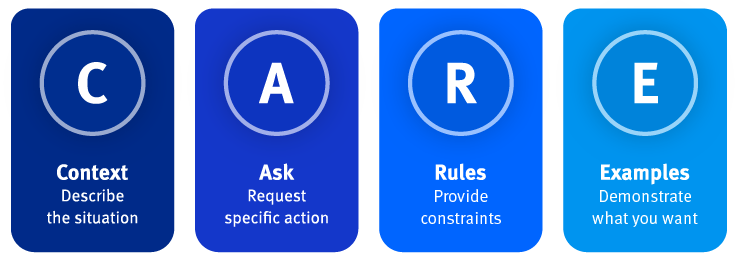
You don't need to be a computer scientist to write good prompts. You just need to be a little more specific. Here are four easy tips:
- Be Super Specific. Instead of "write an email," try "write a polite and friendly email to my boss, Jane, asking for Friday off."
- Give the AI a Role. Start your prompt by telling the AI who to be. "Act like a helpful travel agent..." or "You are a world-class chef..." This puts the AI in the right mindset.
- Provide Context. Give it some background information. Instead of "summarize this," try "summarize this article for me. I'm a busy student, so focus only on the three main arguments."
- Tell it the Format You Want. Don't be afraid to ask for exactly what you need. End your prompt with phrases like "...list the answer in bullet points," or "...put the results in a simple table," or "...write it as a social media post."
Why This Matters
Learning how to write a good prompt is the single best way to get better results from AI. It's not a technical skill; it's a communication skill.
By being clearer and more specific, you move from being a confused user to a confident director, telling the AI exactly what masterpiece you want it to create.